
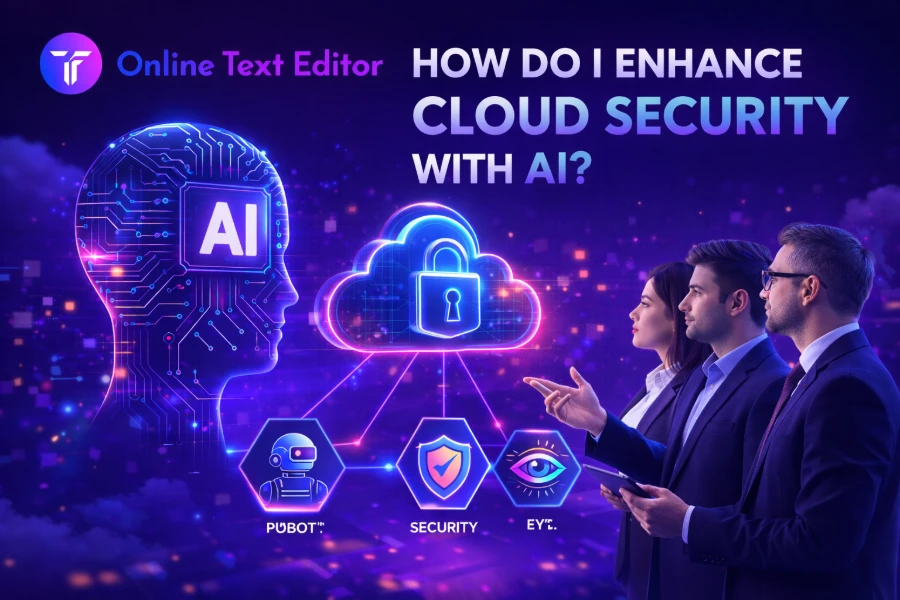
Cloud environments evolve fast, and traditional security methods often struggle to keep up with modern threats. AI introduces speed, intelligence, and automation that help you detect, prevent, and respond to risks more effectively.
If you want to protect your cloud systems while staying ahead of cybercriminals, understanding how AI strengthens security is essential. This guide walks you through practical, proven ways to enhance cloud security with AI while keeping your systems resilient and efficient.
How AI Improves Cloud Security
AI transforms cloud security by analyzing vast amounts of data faster than any human team could. It identifies unusual patterns, predicts threats, and responds in real time to reduce risk exposure.
Instead of reacting after a breach, AI enables proactive security by continuously monitoring activities and flagging suspicious behavior instantly. This shift from reactive to predictive security is what makes AI essential in modern cloud environments.
Security teams also benefit from automation, which reduces manual workloads and allows them to focus on strategic decisions. When you combine intelligent detection with automation, you create a stronger, faster, and more reliable defense system.
Interestingly, automation tools outside cybersecurity follow similar logic, and platforms like small fonts text generator demonstrate how structured automation simplifies complex formatting tasks while maintaining consistency across outputs.
Use AI For Real Time Threat Detection
AI-powered systems analyze logs, user behavior, and network activity in real time. This allows you to detect threats such as malware, unauthorized access, and unusual data transfers instantly.
Traditional tools rely on predefined rules, but AI adapts and learns from new threats continuously. This means your security improves over time without constant manual updates.
You can also reduce false positives, which often overwhelm security teams. AI filters noise and highlights only genuine threats, helping you respond faster and more accurately.
Key Benefits Of Real Time Detection
- Immediate threat identification
- Reduced response time
- Lower false alarm rates
Strengthen Identity And Access Management With AI
Identity and Access Management (IAM) is one of the most critical parts of cloud security. AI enhances IAM by analyzing user behavior and detecting anomalies in login patterns or access requests.
If a user suddenly logs in from a different location or accesses unusual resources, AI flags it immediately. This helps prevent insider threats and compromised credentials from causing damage.
AI can also enforce adaptive authentication, requiring additional verification only when risk levels increase. This improves both security and user experience.
Understanding systems that manage structured data and workflows is similar to learning concepts explained in what is a text editor, where tools process inputs efficiently to deliver organized outputs.
Automate Security Operations With AI
Manual security operations are slow and prone to errors. AI automates tasks such as threat detection, patch management, and incident response, ensuring faster and more consistent protection.
Automation allows your system to respond to threats instantly without waiting for human intervention. For example, AI can isolate compromised systems or block malicious IP addresses automatically.
This reduces downtime and minimizes damage during an attack. It also ensures that security policies are enforced consistently across all cloud resources.
Learning how systems handle structured input and editing processes can be related to workflows discussed in how do i edit a paste txt file in a text editor, where efficiency and accuracy are essential for handling data properly.
Improve Data Protection With AI Driven Encryption
AI enhances encryption by dynamically adjusting security measures based on risk levels. It can detect sensitive data and apply stronger encryption automatically.
This ensures that critical information remains protected even if attackers gain access to the system. AI also helps monitor data movement and prevent unauthorized transfers.
By combining encryption with intelligent monitoring, you create a layered defense strategy that protects both data at rest and in transit.
Use Predictive Analytics To Prevent Attacks
Predictive analytics uses historical data and machine learning to forecast potential threats. AI identifies patterns and predicts where vulnerabilities may exist.
This allows you to fix issues before attackers exploit them. Instead of waiting for incidents to occur, you proactively strengthen weak points in your system.
Predictive security reduces risks significantly and helps you stay ahead of evolving cyber threats.
Detect Insider Threats With Behavioral Analysis
Insider threats are difficult to detect because they often involve authorized users. AI analyzes behavior patterns to identify suspicious actions that deviate from normal activity.
For example, if an employee suddenly accesses sensitive files outside their role, AI flags the behavior. This helps prevent data breaches caused by internal actors.
Behavioral analysis adds an extra layer of protection that traditional security tools cannot provide.
Enhance Cloud Compliance And Auditing
AI simplifies compliance by automating monitoring and reporting processes. It continuously checks your systems against regulatory standards and flags violations.
This ensures that your organization stays compliant without manual audits. AI also generates detailed reports that help you understand security performance.
With automated compliance, you reduce risks associated with regulatory penalties and data breaches.
Secure Multi Cloud Environments With AI
Managing multiple cloud platforms increases complexity and risk. AI provides centralized visibility across all environments, making it easier to monitor and secure resources.
It detects inconsistencies, misconfigurations, and vulnerabilities across different platforms. This ensures consistent security policies regardless of where your data is stored.
Centralized AI monitoring simplifies cloud security management and improves overall efficiency.
Protect AI Systems From New Threats
While AI improves security, it also introduces new risks such as model manipulation and prompt injection. You must secure AI systems just like any other critical infrastructure.
This includes monitoring AI outputs, validating inputs, and controlling access to models. Without proper protection, attackers can exploit AI systems themselves.
Balancing AI usage with strong security controls ensures long term reliability and trust.
Use AI For Incident Response And Recovery
AI accelerates incident response by identifying threats and executing predefined actions instantly. This reduces the time between detection and resolution.
It can also analyze incidents to determine root causes and recommend improvements. This helps prevent similar attacks in the future.
Faster response times mean less damage and quicker recovery for your systems.
Optimize Security Costs With AI
AI helps reduce operational costs by automating repetitive tasks and improving efficiency. You spend less time on manual monitoring and more on strategic improvements.
It also minimizes the financial impact of breaches by preventing attacks before they occur. This makes AI a cost effective solution for cloud security.
By investing in AI, you achieve better protection while optimizing your security budget.
Build A Strong AI Driven Security Strategy
To enhance cloud security with AI effectively, you need a clear strategy. Start by identifying your security needs and selecting the right AI tools.
Ensure that your team understands how to use AI systems and interpret results. Training and awareness are key to maximizing AI benefits.
Finally, combine AI with traditional security practices to create a comprehensive and resilient defense system.
Conclusion
Enhancing cloud security with AI is no longer optional if you want to stay protected in today’s digital landscape. AI empowers you to detect threats faster, automate responses, and predict vulnerabilities before they become serious problems.
By combining real time monitoring, behavioral analysis, automation, and predictive intelligence, you build a security framework that adapts to evolving threats. The key is to balance AI capabilities with strong governance and continuous monitoring to ensure long term protection.
When implemented correctly, AI transforms cloud security into a proactive, intelligent system that keeps your data safe while improving efficiency and reducing risk.
FAQs
How does AI improve cloud security in modern environments
AI improves cloud security by analyzing large datasets to detect threats, automate responses, and predict risks. It reduces human error, enhances visibility, and enables faster incident response, helping organizations secure complex cloud infrastructures more efficiently and proactively against evolving cyber threats.
What are the main benefits of using AI for cloud security
AI offers faster threat detection, reduced false positives, automated responses, and predictive risk analysis. It improves efficiency, strengthens protection, and minimizes downtime, allowing businesses to manage security operations at scale while adapting quickly to new vulnerabilities and sophisticated cyberattacks.
Can AI detect cyber threats in real time
Yes, AI can monitor network activity, user behavior, and system logs continuously to detect threats in real time. It identifies anomalies instantly, allowing security teams to respond quickly and prevent breaches before they escalate into serious incidents affecting business operations or sensitive data.
How does AI help with identity and access management
AI enhances identity and access management by analyzing user behavior patterns and detecting anomalies in login activities. It enables adaptive authentication, flags suspicious access attempts, and ensures only authorized users can access sensitive resources, reducing the risk of insider threats and credential misuse.
Is AI effective in preventing data breaches in the cloud
AI helps prevent data breaches by identifying vulnerabilities, monitoring data movement, and enforcing encryption policies. It detects unusual behavior and blocks unauthorized access, ensuring sensitive information remains protected across cloud environments while minimizing the chances of data exposure or unauthorized transfers.
What role does machine learning play in cloud security
Machine learning enables systems to learn from historical data and improve threat detection over time. It identifies patterns, adapts to new attack methods, and enhances predictive capabilities, making cloud security more intelligent and responsive to evolving cybersecurity challenges without requiring constant manual updates.
How does AI reduce false positives in security alerts
AI analyzes context and behavior patterns to distinguish real threats from normal activity. By filtering irrelevant alerts, it reduces false positives, allowing security teams to focus on genuine risks and respond more efficiently without being overwhelmed by unnecessary notifications or distractions.
Can AI automate cloud security operations
Yes, AI automates tasks such as monitoring, threat detection, patch management, and incident response. Automation ensures faster reactions, consistent policy enforcement, and reduced manual workload, helping organizations maintain strong security while improving operational efficiency and minimizing the risk of human error.
Are there risks associated with using AI in cloud security
AI introduces risks such as model manipulation, data poisoning, and prompt injection attacks. Without proper safeguards, attackers can exploit AI systems, so organizations must implement strong controls, monitoring, and governance to ensure AI tools remain secure and reliable in cloud environments.
What is the best way to implement AI in cloud security
The best approach is to combine AI tools with existing security frameworks, train teams on AI usage, and continuously monitor performance. Start with high-risk areas, integrate automation gradually, and ensure proper governance to maximize benefits while maintaining strong and consistent security practices.